
AI in Education
What Is "AI Workslop" - and Is Your Training Full of It?
There's a new term making rounds in L&D circles: AI workslop.
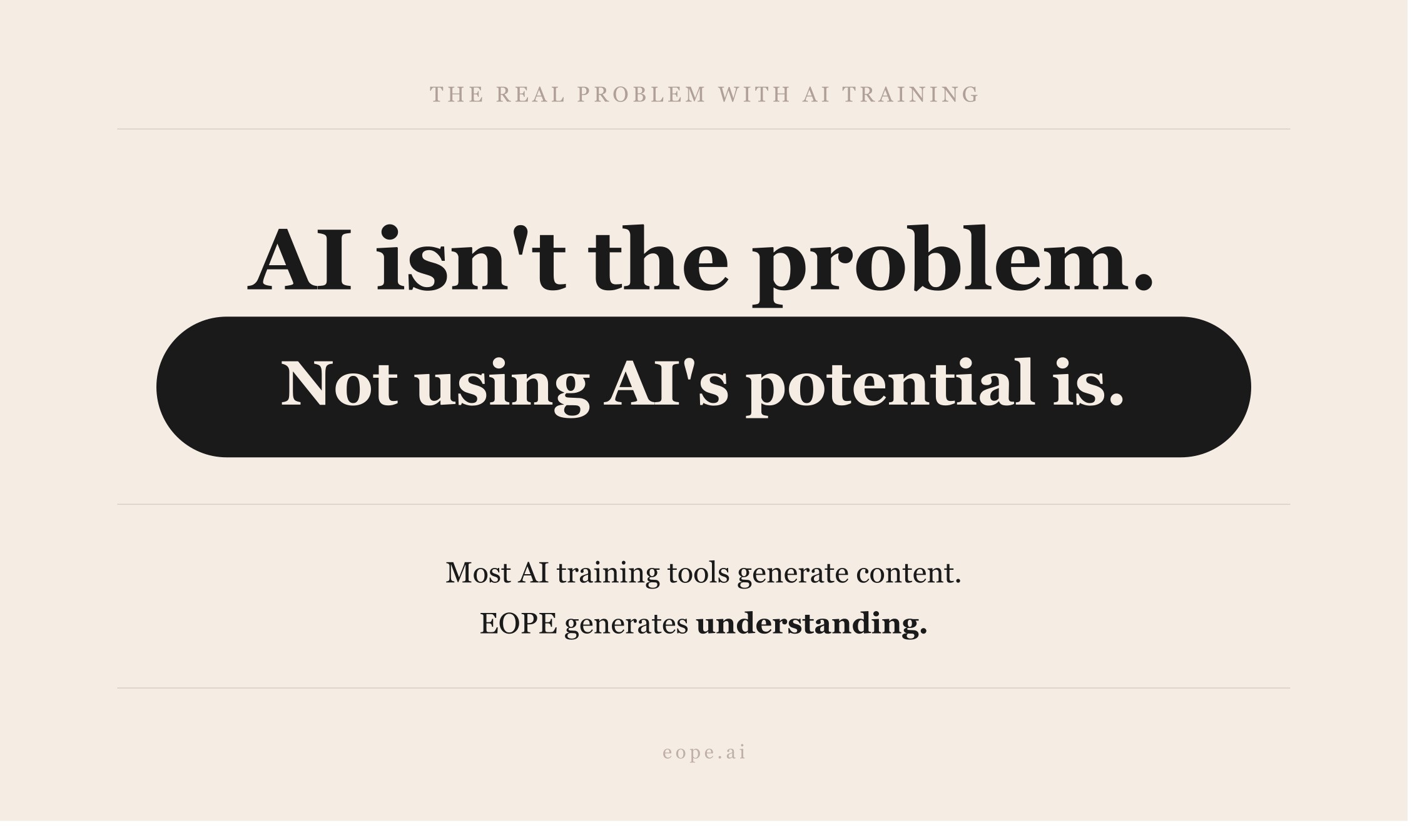
It was coined by researchers at BetterUp Labs and Stanford Social Media Lab to describe a pattern they kept seeing: companies rushing to look AI-ready, producing polished, well-formatted training content - that nobody actually learns from.
The slides are clean. The modules are complete. The completion rates look great.
But ask an employee to apply what they learned three days later? Blank stare.
Why It Happens
Most AI tools used in corporate training were built to generate content, not to teach.
They summarize documents. They format information. They produce quizzes with four answer options and a green checkmark when you pick the right one.
What they don't do is check whether understanding actually happened. They don't ask follow-up questions. They don't adapt when a learner is struggling. They don't create the kind of cognitive friction that makes knowledge stick.
The result is training that looks like learning but functions like reading - passive, forgettable, and easily clicked through.
The Difference Between Content and Learning
Cognitive science has known for decades that people don't learn by consuming information. They learn by retrieving it, applying it, and getting feedback on whether they got it right.
This is why a good teacher doesn't just present slides - they ask questions, challenge assumptions, create scenarios, and force the learner to think.
Most e-learning was never designed to do this. And most AI tools are simply making that same content faster.
How to Spot AI Workslop in Your Organization
Ask yourself:
Does your training measure completion or competence?
Can your employees explain what they learned - or just that they finished?
Does your content adapt to individual knowledge gaps, or is it the same for everyone?
When was your training last tested against real-world performance?
If the answers are uncomfortable, you're probably not alone. The TalentLMS 2026 L&D Report found that 89% of HR managers are satisfied with their training programs - while employees tell a different story.
What Actually Works
Training that works shares a few common traits: it's personalized, dialogue-based, and scenario-driven. It doesn't ask "did you read it?" - it asks "can you apply it?"
This is harder to build. It requires understanding pedagogy, not just content production. But it's the difference between a compliance checkbox and a workforce that actually knows what to do.
At EOPE, we built our AI on a pedagogical framework validated by Tallinn University - specifically to close the gap between content generation and real learning. If you're rethinking how your organization trains, we'd love to show you what that looks like in practice. eope.ai


